
Data Standardization Is the Real Foundation of Military AI
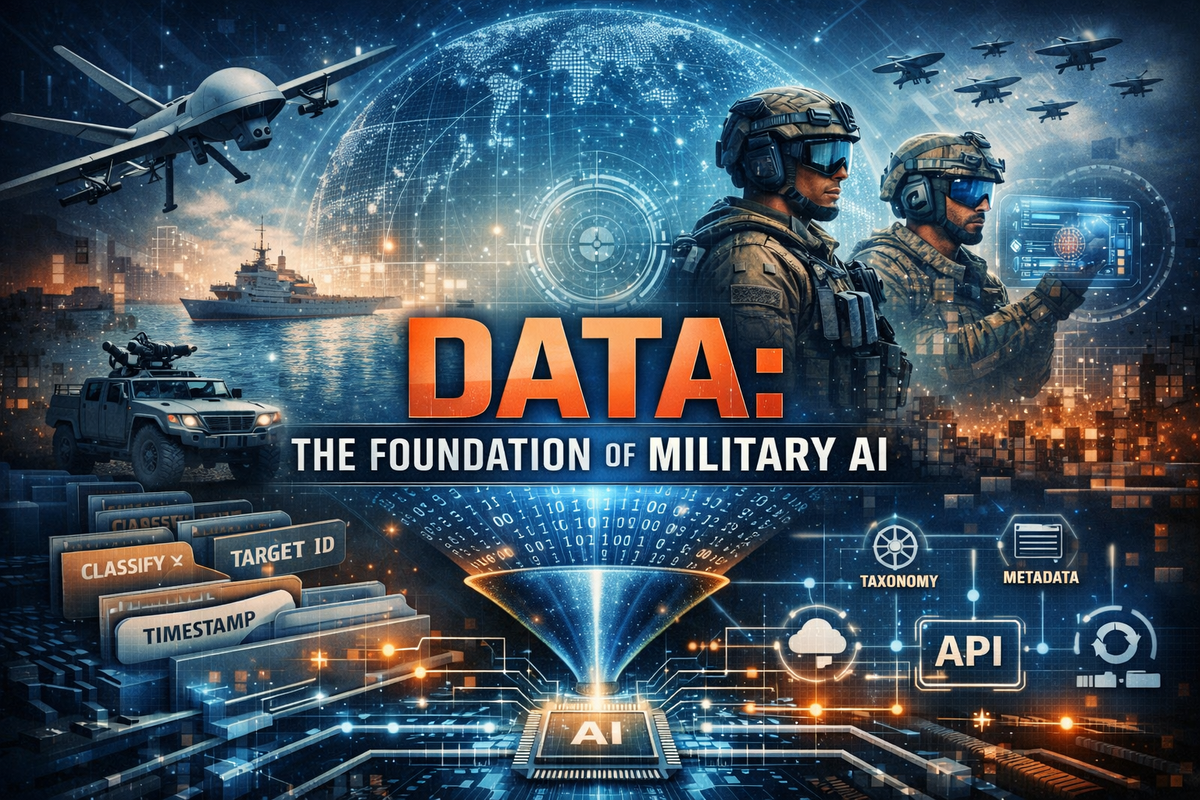
AI-enabled planning assistants, computer vision-based targeting systems, autonomous unmanned system (UxS) swarms, and resilient multi-agent operations all depend on one foundational requirement: clean, labeled, standardized data flowing through open interfaces.
One of the quietest, but most consequential, conversations inside the Department of War is not about drones, large language models, or autonomous agents.
It is about data.
Specifically: how we label it, tag it, govern it, and standardize it across the enterprise so that future AI systems can actually learn, operate, and make decisions at scale.
This is not a theoretical concern. It is the limiting factor for every serious AI-enabled capability the Department wants to field.
At SOCPAC, we learned this lesson the hard way: you cannot scale autonomy unless you first standardize the data that feeds the models.
Why Department-Wide Data Standardization Is No Longer Optional
AI-enabled planning assistants, computer vision-based targeting systems, autonomous unmanned system (UxS) swarms, and resilient multi-agent operations all depend on one foundational requirement: clean, labeled, standardized data flowing through open interfaces.
Without that foundation, the rest is just demos and pilots.
The uncomfortable truth is this:
models and autonomous systems are increasingly commodities. The real differentiator is not the algorithm; it is the data architecture beneath it.
If the data is fragmented, inconsistently labeled, or trapped in closed systems, the AI will never perform reliably, no matter how advanced the model claims to be.
Why Labeling and Metadata Tagging Actually Matter
Large language models and computer vision systems do not learn from raw data. They learn from structured, labeled, and standardized data.
When every organization uses different schemas, naming conventions, and metadata standards, models cannot generalize across the enterprise. When metadata is incomplete or inconsistent, autonomous systems cannot reason with confidence. When provenance and context are missing, trust collapses.
In operational terms, this means:
- Planning assistants hallucinate or provide brittle recommendations
- Targeting systems fail to fuse sensor inputs correctly
- Autonomous platforms cannot coordinate across domains
- Multi-agent systems break under real-world uncertainty
This is not an AI problem. It is a data governance problem.
Industry Solved This Years Ago
The private sector already learned this lesson.
Every high-performing AI-driven organization, whether in logistics, finance, manufacturing, or technology, invests heavily in centralized data governance. Not as a compliance exercise, but as a strategic enabler.
These organizations consistently implement:
- Global taxonomies and authoritative data dictionaries
- Unified metadata schemas across the enterprise
- Automated labeling and enrichment pipelines
- Standardized, well-documented APIs for every system
- Platform-independent data transport layers
This is how they scale AI from experimentation to production. This is how they deploy autonomy with confidence.
The Public Sector Must Move Now
The Department cannot afford to treat data standardization as a future modernization effort or a 2030 objective.
AI-enabled warfare timelines do not allow for that luxury.
Every year we delay:
- Fragmentation deepens
- Technical debt compounds
- Autonomy becomes harder, not easier, to field
Data governance must be treated as foundational warfighting infrastructure, not a back-office IT concern.
The Bottom Line
We will not build autonomous UxS fleets, resilient multi-agent coordination systems, or LLM-driven operational workflows without clean, labeled, standardized data moving through open interfaces.
Data standardization is not bureaucratic overhead.
It is not optional.
It is not incremental.
Data standardization is national defense.


Comments ()