
Decision-Making at the Speed of Conflict: A Guide for DoW Tech Ventures
One common mistake is developing a technology in isolation and then shopping it around, hoping someone finds a use for it. This “tool in search of a mission” approach often falters. Why?
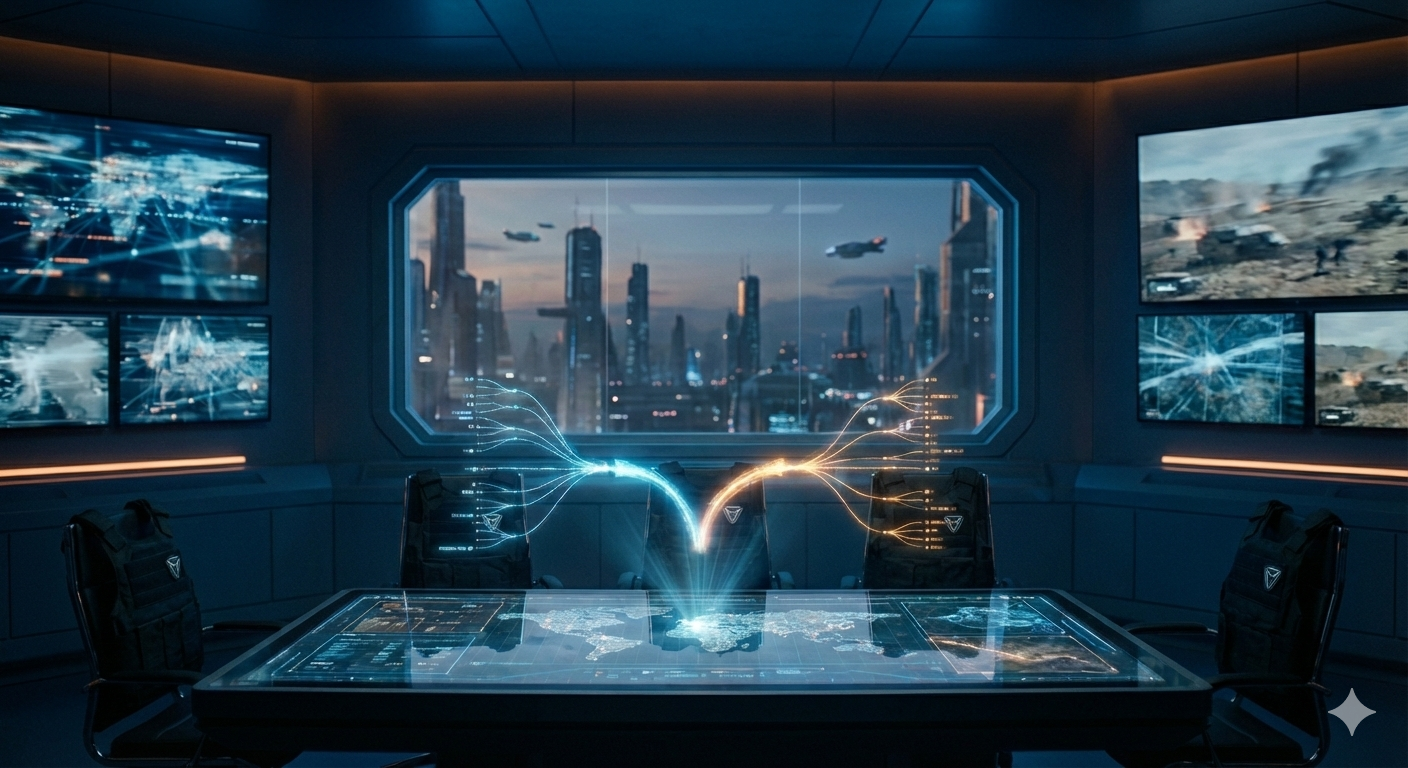
In the Department of War (DoW), success begins with a singular focus: enabling decisions at the speed of conflict. Nowhere is this more apparent than in the Joint Operations Center (JOC), where the pressure is on the J33 (Current Operations) and J35 (Future Operations) to understand the situation, plan, and execute faster than the adversary. For venture capital firms and startups eyeing the national security sector, the message is clear: any technology you bring to the fight must serve this core problem of rapid, informed decision-making in warfighting environments.
The JOC: Where Speed and Clarity Matter Most
In a wartime JOC, time is the most precious commodity. The J33 and J35 staff face incoming reports, emerging threats, and shifting orders in real time. Decisions that normally take hours or days in peacetime must be made in minutes or seconds under fire. Joint doctrine stresses that commanders and staff must “plan and execute at the speed of relevance”. This means battle rhythms and processes are laser-focused on supporting decisions across current, near-term, and future operations, all at once. Startups often hear buzzwords like “JADC2” or “hyperwar”, but at its heart, this is about delivering the right information to the right decision-maker at the right time, despite chaos.
Consider the roles: J33 (Current Ops) manages the fight that’s happening right now, the air strikes being called in, the cyber defenses going up, the units maneuvering this hour. J35 (Future Ops) plans the next moves, anticipating where the fight is going in the coming hours or days and preparing fragmentary orders (FRAGOs) and branch plans to stay ahead. Together, they execute the commander’s intent on tight timelines. Every other staff section exists to feed these two engines of decision. If your product doesn’t help the ops center make faster or better calls under pressure, it’s not addressing the DoW’s core problem.
Seven Warfighting Functions: The Staff’s Backbone
To understand how to integrate technology effectively, startups must grasp the seven warfighting functions, the broad categories of capability that any military operation requires. Joint doctrine categorizes all military activities into the following functions: mission command (command and control), movement and maneuver, fires, intelligence, sustainment (logistics), protection (force protection), and information. Each warfighting function has a corresponding joint staff expertise: for example, J2 (Intelligence) drives the intelligence function, J4 (Logistics) oversees sustainment, J6 (Communications/Cyber) underpins both the information and command-and-control functions.
Importantly, these functions aren’t siloed; they converge in the JOC to serve current and future ops. The Joint Staff directorates (J-codes) were created “to ensure a joint staff has the right mix of expertise across key areas”, aligning with warfighting functions, all in support of the commander’s decisions. In practice, this means:
- Mission Command (C2): Led by the command section and J3 Ops, enabled by J6 comms, ensuring the commander can issue orders and receive reports in real time.
- Movement and Maneuver: Planned by J3/J5 and executed by units, with J3 Current Ops synchronizing movements on the battlefield.
- Intelligence: Driven by J2, providing situational awareness and predictive analysis so J33/J35 know what’s happening and what’s coming.
- Fires: Coordinated by J3 (often via a fires cell), integrating artillery, airstrikes, cyber fires, etc., in support of the scheme of maneuver.
- Sustainment: Managed by J4, ensuring fuel, ammo, maintenance, and medical support keep the fight going, which J35 must factor into future plans and J33 monitors for current ops.
- Protection: Shared by many, force protection and air/missile defense (often under J3), engineering (J4/J7), etc., to shield the force and preserve combat power.
- Information: A newer function spanning cyber, comms, and information operations (J6 and J3 staffs), maintaining networks, disrupting enemy C2, and shaping the information environment.
All these staff efforts funnel into helping J33 and J35 execute the mission. Think of the warfighting functions as gears in a machine; if one gear slips (say comms go down, or intel is faulty), the decision-making machine in the JOC grinds slower or even stalls. Any tech solution must appreciate this interplay. A flashy standalone tool that doesn’t integrate with these functions or strains one of them (e.g., requires perfect comms or constant human attention) will be a burden, not a boon.
How Operations and Planning Are Structured (What the Joint Pubs Say)
Joint Publications 3-0, 5-0, 3-33, etc., lay out how a joint force headquarters plans and fights. The key concept is three overlapping planning horizons: current operations, future operations, and future plans. Most headquarters assign these to different teams or sections:
- Current Operations (J33 cell under J-3): handles the immediate fight (often within <24 hours), running the JOC, monitoring ongoing operations, and making quick adjustments. “Current operations planning addresses immediate or very near-term issues... in the JOC under J-3”.
- Future Operations (J35 cell under J-3): looks branch plans FRAGOs that anticipate changes or the next phase of the fight. Doctrine notes that “future operations ensure continuity between J-5 planning and current ops”. In other words, J35 translates the big-picture plan into actionable tasks once conditions are right, so the commander is never caught flat-footed.
- Future Plans (J-5 Plans Directorate): works on the longer-term sequels, the next campaign phase, or major operation beyond 72 hours or even weeks ahead. They produce OPLANs or major contingencies, which feed ideas to J35 when it’s time.
A startup breaking into national security should map its solution to this framework. Are you helping with immediate execution (J33 needs)? Near-term planning (J35 needs)? Or longer-term analysis (J5 realm)? For example, an AI tool that helps course-of-action analysis might live in Future Plans, while an AI that flags anomalies in live sensor feeds aids Current Ops. If you don’t know, spend time with operators to find out. A brilliant tool in the wrong context is as good as no tool at all.
What Not to Do: Tech in Search of a Mission
One common mistake is developing a technology in isolation and then shopping it around, hoping someone finds a use for it. This “tool in search of a mission” approach often falters. Why? Because it puts the gadget before the problem. The reality is that commanders care about outcomes, not the elegance of your algorithm or the sophistication of your drone. If a product doesn’t directly alleviate a pain point or enhance a capability under combat conditions, it will be met with polite interest at best, and indifference or frustration at worst.
Too often, startups focus on glossy demos rather than the gritty details of warfare. As one seasoned team observed, “Too many startups build for a pitch, not a battlefield”. They test in comfy labs with reliable power and full connectivity, assuming ideal conditions. But the battlefield is friction, “It’s degraded comms, bad weather, mission stress, hardware wear, operator confusion, and adversary escalation”. That beautiful user interface means nothing if “the person using it has gloves on, no signal, and 10 seconds to make a life-or-death decision.” In short, demo-ready is not mission-ready.
Consider a real example: a few years ago, a series of AI-enabled targeting tools promised to cut sensor-to-shooter time dramatically (a genuine commander’s problem). The Army even ran exercises with them, and leaders were excited. But the tools never survived the procurement pipeline, in part because they weren’t fully baked for real-world integration and the military’s complex requirements. This isn’t to disparage innovation, but to highlight that hype must meet substance. A flashy capability that isn’t robust under adversarial conditions (electronic jamming, data loss, high user stress) or that can’t mesh with existing workflows will not last in the war arena.
Aligning Innovation with Operational Priorities
So how can commercial tech, from AI and autonomy to logistics and ISR, truly align with warfighting needs? Here are some guiding principles for technologists and investors looking to make an impact:
- Start with the Commander’s Critical Problems: Before writing a line of code or building a prototype, understand what keeps commanders up at night. Is it the speed of target engagement? Logistics convoys getting ambushed? Too much raw intel and not enough insight? Ground your solution in a problem they would gladly pay (or fight) to solve. As the saying goes in military staffs, “Mission drives function,” the mission needs to drive whatever tech function you offer, not the other way around.
- Map to a Warfighting Function: If your product doesn’t clearly improve one of the seven warfighting functions, rethink it. For instance:
- AI for Intelligence: Perhaps your AI can analyze surveillance feeds or social media faster than analysts, providing J2 and J3 with actionable intel in minutes instead of hours. That directly supports the intelligence function and speeds decision cycles.
- Autonomy for Maneuver or Protection: Maybe you develop autonomous vehicles or drones. Frame them in terms of extending maneuver (unmanned systems scouting ahead to buy reaction time) or improving force protection (robots securing a perimeter in high-threat areas).
- Logistics Tech for Sustainment: If you have a supply chain optimization platform or a novel way to deliver ammo or fuel (think drones or AI-driven maintenance prediction), tie it to sustainment at the pace of operations. Show how it keeps the J33 from having to pause operations due to resupply issues.
- Communications/Networks for Mission Command and Information: Perhaps you offer a resilient comms network or data fusion. Highlight how it enables mission command to function under degraded conditions, ensuring the commander’s orders still get through, and sensor data still flows even if satellites or networks are contested.
- ISR (Intelligence, Surveillance, Reconnaissance) for Fires and Intel: If you have a new sensor or imaging tech, demonstrate how it feeds the targeting process (fires function) or fills an intel gap, and importantly, how the data will integrate into existing command systems (so J3 and J2 can actually use it in time).
- Design for the Fog of War: Build your solutions for the worst day, not the best day. Assume networks will be down or intermittent, users will be sleep-deprived and under attack, and data will be incomplete or deceptive. “Incomplete information, tangible consequences, the need for decisive action, and uncertainty… are all facets of stress” in real operations. Your tech should be a relief, not another source of stress. For example, a UI that works with night-vision goggles or gloves, or an AI that flags “good enough” options when data is thin, can be a lifesaver. Always ask: Does this reduce the cognitive or physical burden on the warfighter? If it complicates things, go back to the drawing board.
- Integrate into Decision Processes: Technology must slot into the existing decision loops (or improve them without breaking them). If an HQ runs on a certain battle rhythm of updates and briefings, show how your tool fits in; e.g., providing an automated update to a common operating picture that shaves 10 minutes off the briefing prep each hour. Little wins in time savings or clarity can snowball into big operational advantages. Remember, your users in uniform can’t drop everything to play with a new gadget; your solution has to meet them where they are in their workflow.
Engage with Warfighters as Partners, Not Just Customers
Finally, a critical piece of advice: get out there and engage with the practitioners on their terms. The frontline staff and officers are not merely buyers; they are the people who will live or die by how well a system works when the chips are down. Treat them as teammates whose feedback is pure gold.
Spend time in command centers, attend military exercises, and listen more than you talk. When a staff officer in J33 says an interface is confusing, or an NCO in supply points out a flaw in your drone’s battery life, pay attention. These folks are executing mission tasks under extreme time pressure, with incomplete information, in degraded environments, exactly the conditions your tech must handle. Empathize with their context: a thriving team, as one Air Force captain noted, “can. overcome operational adversity and excel in the fog of war”. Your product should be part of that overcoming, a source of resilience and clarity amid chaos.
One practical approach is to embrace a bit of military methodology yourself: red-team your product. Invite friendly skeptics (ex-special operators, experienced military users) to stress-test your solution in a mock field environment. As one national security tech team put it, startups need someone to “simulate failure on purpose… to show them where they break before the battlefield does”. It’s better to have a former Army major or Air Force tech sergeant thrash your system in an exercise than to have it fail for a real unit in combat. By iterating with the end-users in mind, you’ll build credibility. And in this field, trust is the true currency. “In, national security, trust is the true product… it comes from pressure”, proven performance under stress.
Conclusion: Winning Speed, Earning Trust
Breaking into the Department of War as a startup or investor is not for the timid. The national security enterprise is complex and often resistant to change, but it desperately needs solutions that truly help warfighters. The key is to anchor on the mission: speeding up the decision cycle and empowering those in the JOC and on the battlefield to outthink and outpace the enemy. That means doing your homework through the lens of joint doctrine and warfighting functions, and delivering tech that soldiers, sailors, airmen, and Marines will find practical and reliable when the fog of war sets in.
If you can demonstrate that your innovation plugs into the way the military plans and fights, that it makes a J33 or J35’s life easier, even under extreme conditions, you will find receptive allies in uniform. Solve the commander’s problems, not the problem you imagine they have. In the high-stakes arena of conflict, solutions that enable faster, smarter decisions are worth their weight in gold, and those who provide them will earn the trust and lasting partnership of the DoW. The battlefield moves fast; help the warfighter move faster, and you’ll not only break into the DoW market, but you’ll make a real difference where it counts.



Comments ()