
Ghost Fleet Showdown: How Autonomy and Innovation Can Close China’s Shipbuilding Gap
Instead, the United States can outpace this advantage through agility, autonomy, and innovation.
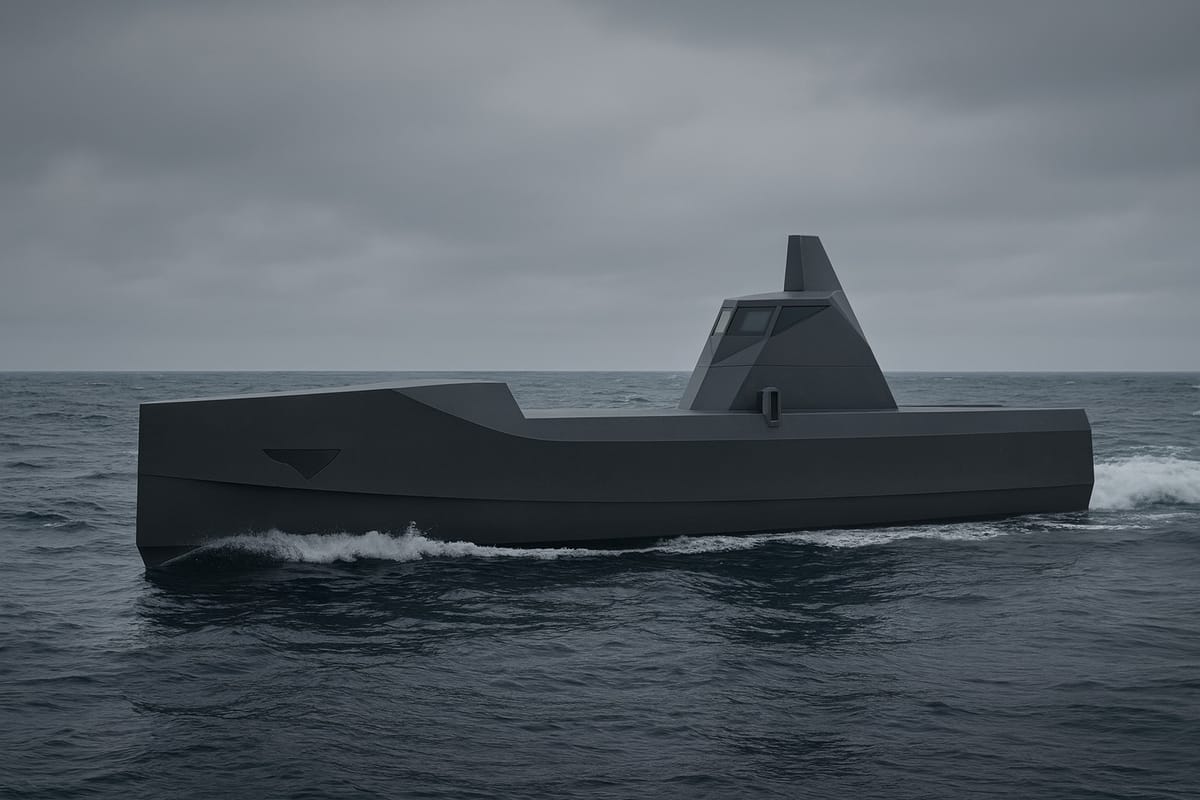
China’s naval shipyards are churning out a “ghost fleet” at an astounding pace. Palmer Luckey, tech entrepreneur and founder of national security firm Anduril, recently sounded the alarm that China has “350 times more shipbuilding capacity than the U.S.”, thanks to a centralized, whole-of-nation strategy. In China, even civilian vessels are built to military standards by law, creating a latent warfleet-in-waiting that can be nationalized overnight. This civil-military fusion means Beijing can convert ferries into tank transports or container ships into missile launchers on short notice. It’s a blisteringly efficient model: Rep. Raja Krishnamoorthi noted China can produce 359 ocean-going ships for every one the U.S. builds. Little wonder U.S. strategists see a yawning vulnerability on the high seas, a numeric imbalance that could tip the scales in a conflict over Taiwan or the South China Sea.
Yet America need not respond symmetrically by trying to build 350 times more ships. Instead, the United States can outpace this advantage through agility, autonomy, and innovation. The solution lies in unleashing America’s diversified ecosystem of national security startups, autonomous systems, and public-private ingenuity to field swarms of smaller, smarter forces that render China’s massed ship advantage less decisive. As Luckey himself put it, manned fleets alone will never keep up: “That’s why we’re building warships with autonomy”.
The Dragon’s Assembly Line vs. the Arsenal of Democracy
China’s shipbuilding juggernaut is the product of a commanded national effort. Beijing treats shipyards as strategic assets, propped up by massive state subsidies and protectionist policies. Commercial shipbuilders in China effectively work for the PLA Navy: a 2017 law mandates that new cargo ships, ferries, and tankers include military features like reinforced decks for armored vehicles. The result is a ghost fleet of civilian vessels that can be pressed into military service en masse, an armada hidden in plain sight. This top-down, high-volume approach gives China sheer quantity, rapid mobilization capacity, and the ability to replace wartime losses far faster than the U.S. industrial base.
However, such centralized efficiency can also be brittle. A system geared to crank out standardized ships at scale may lack diversity and adaptability. China’s military innovation often lags; that it excels at scaling existing designs, not at nurturing maverick ideas. Over-reliance on a few giant state-owned enterprises means a single point of failure (a design flaw, a targeted strike on a shipyard) could reverberate widely. And a force built on homogeneous “inferior equipment” risks being overwhelmed by novel, superior technology if faced by an adversary that innovates faster. China bets that quantity can overwhelm quality, fielding “enough inferior equipment” to swamp a smaller high-tech force. It’s a numbers game, but one the U.S. can upend by changing the playing field.
America’s Asymmetric Answer: Autonomy, AI, and a Thousand Startups
To close the gap, the United States is leveraging its greatest strengths, innovation and agility, to pursue an asymmetric maritime strategy. Rather than trying to match hull-for-hull, the U.S. and its allies are fielding new kinds of capabilities that multiply force without multiplying cost. Unmanned and autonomous systems, in the air, on the sea, under it, and even in swarms of low-cost “ghost” vessels, can complicate China’s plans and negate the raw numbers advantage. The U.S. does not need 350 shipyards if it can deploy 350 drones for every enemy ship.
Key to this effort is America’s burgeoning national security tech ecosystem of venture-backed startups and innovators. Over the past few years, emerging companies have exploded onto the scene with advanced drones, smart weapons, and software-defined systems that reimagine warfare. Some examples:
- Anduril Industries: Founded by Palmer Luckey, Brian Schimpf, Matt Grimm and Trae Stephens, and Joseph Chen, Anduril builds AI-driven war platforms from counter-drone systems to autonomous sentry towers. It’s now constructing a drone factory in Ohio, the size of 87 football fields, to produce next-generation military drones at scale, reflecting how seriously the U.S. private sector is scaling up. Valued at ~$30 billion, Anduril exemplifies how Silicon Valley-style innovation is being applied to war.
- Saronic: A naval-systems startup developing autonomous surface vessels (“drone boats”). Saronic’s unmanned boats range from 6-foot skiffs to 150-foot robot ships, many deployable in swarms. These drone boats are cheaper to build and operate than manned warships and can be fielded in large numbers to swarm and overwhelm larger enemy vessels. Saronic even acquired a Louisiana shipyard to ramp up production, illustrating how a nimble startup can inject new capacity into U.S. shipbuilding. By 2025, it reached “unicorn” status with a $4B valuation, underlining investor confidence in autonomous naval tech.
- Shield AI: A pioneer in AI piloting software, Shield AI develops autonomous flight systems for drones and aircraft. Its “Hivemind” AI has already flown F-16 fighters in training, and its combat drones aim to act as loyal wingmen to U.S. pilots. Shield AI’s success (valued at around $2.8B) shows how software-centric approaches can rapidly enhance legacy platforms with autonomy.
- PDW (Performance Drone Works): A cutting-edge drone manufacturer building small, expendable drones in large volumes. PDW just opened a high-tech drone factory in Huntsville, AL, aiming to produce hundreds of UAVs and create 500 jobs. Startups like PDW combine battlefield insights with Silicon Valley engineering to deliver capabilities that big contractors have overlooked; for example, swarming micro-drones and affordable loitering munitions.
This diverse ecosystem, from AI software to unmanned ships and expendable drones, is America’s answer to brute-force shipbuilding. It provides redundancy and variety: no single Chinese target (ship or factory) can knock out America’s combat power, because that power is distributed across many smaller systems and companies. A Chinese carrier might face not another carrier, but a wolfpack of autonomous torpedo boats, aerial drone swarms, and undersea robots all at once. By embracing a mosaic of autonomous platforms, the U.S. can impose dilemmas on China that sheer hull numbers can’t easily solve.
Equally important, the U.S. is blending public and private strengths to achieve this. Legacy primes, Boeing, Lockheed Martin, Northrop Grumman, etc., bring deep manufacturing know-how and integration expertise, while the new startups bring software talent, rapid iteration, and bold ideas. The Pentagon is actively knitting these together. In fact, national security tech firms have doubled their share of Pentagon contracts over the past year as DoW seeks to tap their innovation. U.S. War Secretary Pete Hegseth declared the goal to “move away from a ‘prime’ dominated culture to a system where nimbler commercial companies speed up weapons production,” all to counter China’s rapid military buildup.
This shift is a whole-of-nation (democratic style) approach: instead of one central plan, Washington is catalyzing a thousand innovators through funding, competitions, and partnerships (from AFWERX challenges to the at Navy’s Ghost Fleet Overlord program). Venture capital is on board too, with over $5B invested in national security startups like SpaceX, Anduril, Rebellion, Epirus, and more. The result is a resurgent Arsenal of Democracy, where entrepreneurs and engineers join forces with admirals and generals.
Resilience Through Diversity vs. the Brittle Behemoth
While China’s centralized strategy yields impressive output, it also locks them into a relatively inflexible force. In contrast, America’s diversified approach is messier but more resilient. Dozens of different autonomous systems, developed by independent teams, create a web of capabilities that is difficult to predict and counter. This heterogeneity is a strength: some systems will fail or be less effective, but others will excel, and the whole network can adapt. It’s the Silicon Valley ethos of rapid experimentation applied to national security, akin to how a swarm of startups produces breakthroughs faster than a state-run monopoly.
China’s system can be thought of as a single huge tree, tall, strong, but if the trunk is struck, the whole tree can fall. America is cultivating a forest of many interlinked systems; you can burn part of it, but others will grow in to fill the gap. Moreover, China’s focus on copying and mass-producing existing tech means it could be caught off-guard by a leap-ahead innovation. As noted by many, China may trail slightly in cutting-edge quality today, they copy fast. The U.S. must therefore keep pushing the innovation envelope, through autonomy, AI, and novel concepts of operation, so that China is always reacting, not initiating. By the time China clones a new U.S. drone, a better version or a new tactic (e.g., AI-driven swarming formations) should be in play.
Crucially, America’s strategy also builds redundancy. In World War II, the U.S. triumphed through sheer industrial might; our shipyards out-produced the enemy. Today, instead of one-for-one ship replacement, redundancy comes from many cheap autonomous platforms. If China sinks a $15 million unmanned vessel, the U.S. can have a dozen more ready to deploy. This flips the cost equation and erodes the enemy’s numerical edge. As one OutKick analysis summarized, China can throw everything it has regionally into a fight, while America can only send what it has forward-deployed; that’s a problem to fix. Autonomous systems are how we fix it: they extend our reach (many systems can be forward deployed cheaply) and multiply our force (doing more with fewer humans and big ships).
Innovation Backed by Strategy: Autonomy as Force Multiplier
This transformation isn’t happening in a vacuum; it’s guided by high-level U.S. strategy and policy that recognize technology as the key to future military advantage. Recent strategy documents show a clear emphasis on autonomy, AI, and collaboration to maintain U.S. superiority:
- 2025 U.S. National Security Strategy (NSS): The NSS explicitly prioritizes American leadership in AI, autonomous systems, quantum computing, and other enabling technologies. It calls for harnessing the U.S.’s economic and industrial power to out-innovate strategic competitors. The strategy ties economic security to national security, pushing re-industrialization and tech dominance as core goals. Notably, it promotes the U.S. “AI stack” abroad, encouraging allies to adopt American AI and tech standards, which helps set global norms in our favor. The NSS also indicates support for DoW exports to allies and partners who invest in their own defense and war efforts. This bolsters collective capacity: if U.S. allies field compatible autonomous systems, it magnifies the coalition’s overall strength.
- “Winning the Race: America’s AI Action Plan” (2025): This White House initiative is a roadmap for U.S. AI leadership, built on three pillars: Accelerating AI innovation, Building AI infrastructure, and International AI collaboration. It emphasizes unleashing private-sector innovation by cutting red tape, “AI is far too important to smother in bureaucracy at this stage”, the plan declares. For DoW, the Action Plan includes fast-tracking secure AI infrastructure: e.g., establishing special permits to build high-security data centers for AI, even on federal land, and ensuring America’s AI computing stack is built with U.S. technology (to avoid reliance on adversaries). By investing in AI R&D, talent development, and secure infrastructure, the U.S. ensures the backbone needed to deploy autonomy at scale. The plan’s international pillar also aligns allies on AI standards and usage, which is crucial for interoperability in coalition operations.
- DoW Chief Digital and AI Office (CDAO) & AI Test and Evaluation: The Pentagon is rigorously preparing to integrate AI by developing new testing and evaluation frameworks for AI models, including large language models (LLMs). In 2024, the DoW launched Task Force Lima to accelerate understanding of generative AI and partnered with industry to create domain-specific benchmarks for military AI. Scale AI’s one-year contract with CDAO is yielding methods to measure LLM performance on national security tasks and provide real-time feedback for warfighters. By crafting specialized evaluation sets and “model cards” for AI in military scenarios, the Pentagon will know which AI tools are reliable in, say, organizing battle reports or target recognition. This scalable testing enables the DoW to field AI with confidence. “The rigorous T&E process aims to enhance the robustness and resilience of AI systems... enabling adoption of LLM technology in secure environments,” the CDAO noted. In short, the U.S. is not only inventing new autonomous tech but ensuring it’s battle-tested and trustworthy, turning AI into a true force multiplier rather than a risky experiment.
- Allied Initiatives (e.g., AUKUS Pillar II): America is not doing this alone. U.S. allies are full partners in the autonomy push. Under the AUKUS security pact with the U.K. and Australia, “Pillar II” is dedicated to Advanced Capabilities, chiefly AI, autonomy, quantum, and more. In 2024, the AUKUS partners held breakthrough trials deploying AI-enabled autonomous systems in a combined exercise. These trials linked U.S., Australian, and British drones and sensors into one network, sharing data and AI models in real time to detect and strike targets across land, sea, and air domains. A UK unmanned aircraft used an AI plug-in to spot threats, passed data to an Australian drone for a simulated strike, all coordinated via a U.S. command system with a human “AI officer” in the loop. The lessons learned are feeding into a trilateral AI-and-autonomy ecosystem that will enable seamless joint operations in contested environments. This is exactly the kind of force multiplier that turns a 1x1+1+1 (U.S.+allies) into 3 or 4 on the battlefield. When allies share technology and adopt common standards, it effectively enlarges the “innovation base” competing with China. The United States and partners are thus setting the standards for war autonomy, from interoperability protocols to AI ethics, ensuring the free world leads in this domain.
Charting a Course to Victory through Innovation
Taken together, these developments paint a hopeful picture for America and its allies in the face of China’s raw shipbuilding might. Yes, the challenge is immense; the U.S. must rebuild some of its industrial capacity and guard against over-dependence on Chinese supply chains. And yes, change is hard: adopting a more agile acquisition model means confronting bureaucratic inertia and vested interests. But the foundations are being laid. Washington is committing serious resources, including $29 billion to boost domestic shipbuilding, and nurturing public-private collaborations in everything from microchips to AI startups. The Reagan Defense Forum this year showcased baseball-cap-clad tech founders mingling with four-star generals, all focused on scaling new capabilities fast. The cultural shift is underway.
Ultimately, America’s enduring advantages are its people, creativity, and allies. A decentralized, entrepreneurial society like the U.S. can muster innovations that a top-down system struggles to match, and do so in unpredictable ways. By harnessing that spirit through smart policy (as seen in the AI Action Plan and NSS) and by investing in emerging tech talent, the U.S. can leapfrog a quantitatively superior adversary. Every autonomous drone wingman or uncrewed “ghost ship” added to the U.S. arsenal shrinks the relevance of China’s 350x shipyards. Every AI that helps a commander make faster decisions negates some of the numerical weight of China’s forces. This is how David beats Goliath in the 21st century, not with a bigger club, but with a smarter strategy.
America and its allies are poised not only to match China’s challenge but to define the future of warfare on our terms. A future where dominance is determined by who innovates faster and adapts better, not who has the biggest factory. By embracing autonomy, fostering public-private innovation, and doubling down on the strengths of open societies, the United States can ensure that the free world retains a decisive edge. We will sail into this new era with confidence, a ghost fleet of our own at our back (crewed by algorithms and guided by our values), ready to deter aggression and preserve peace. In the contest between an autocratic mass-production model and a democratic innovation model, bet on innovation; it’s the one thing that freedom, ingenuity, and true partnership can deliver in overwhelming force. America’s course is set, and it’s one of hope, resilience, and victory through innovation.



Comments ()