Race for AI Supremacy: How U.S.-China Competition in Artificial Intelligence Could Shape the Future
China has declared its intent to be the world’s AI leader by 2030, pouring massive state investment into achieving that goal. The U.S., in turn, has launched an ambitious national AI strategy to supercharge its AI capabilities while upholding democratic values.
Summary: Few technologies will influence the balance of global power in the next decade as much as artificial intelligence. The United States and China are locked in a high-stakes race for AI leadership, a contest that could define economic might and military strength in the years ahead. China has declared its intent to be the world’s AI leader by 2030, pouring massive state investment into achieving that goal. The U.S., in turn, has launched an ambitious national AI strategy to supercharge its AI capabilities while upholding democratic values. This article unpacks why AI is such a pivotal arena in U.S.-China rivalry, how each nation is striving for an edge, and what’s at stake for the global community.
Why AI Dominance Matters
Artificial intelligence isn’t just another tech trend; it’s increasingly seen as the foundation of future economic growth and military power. Analysts project that the country that best integrates AI across its economy “stands to reap trillions in new value added and efficiency gains,” reinforcing its financial strength. AI-driven automation can revolutionize industries from manufacturing to healthcare. In short, the AI winners could unlock unprecedented productivity booms, giving them a huge competitive advantage in global markets.
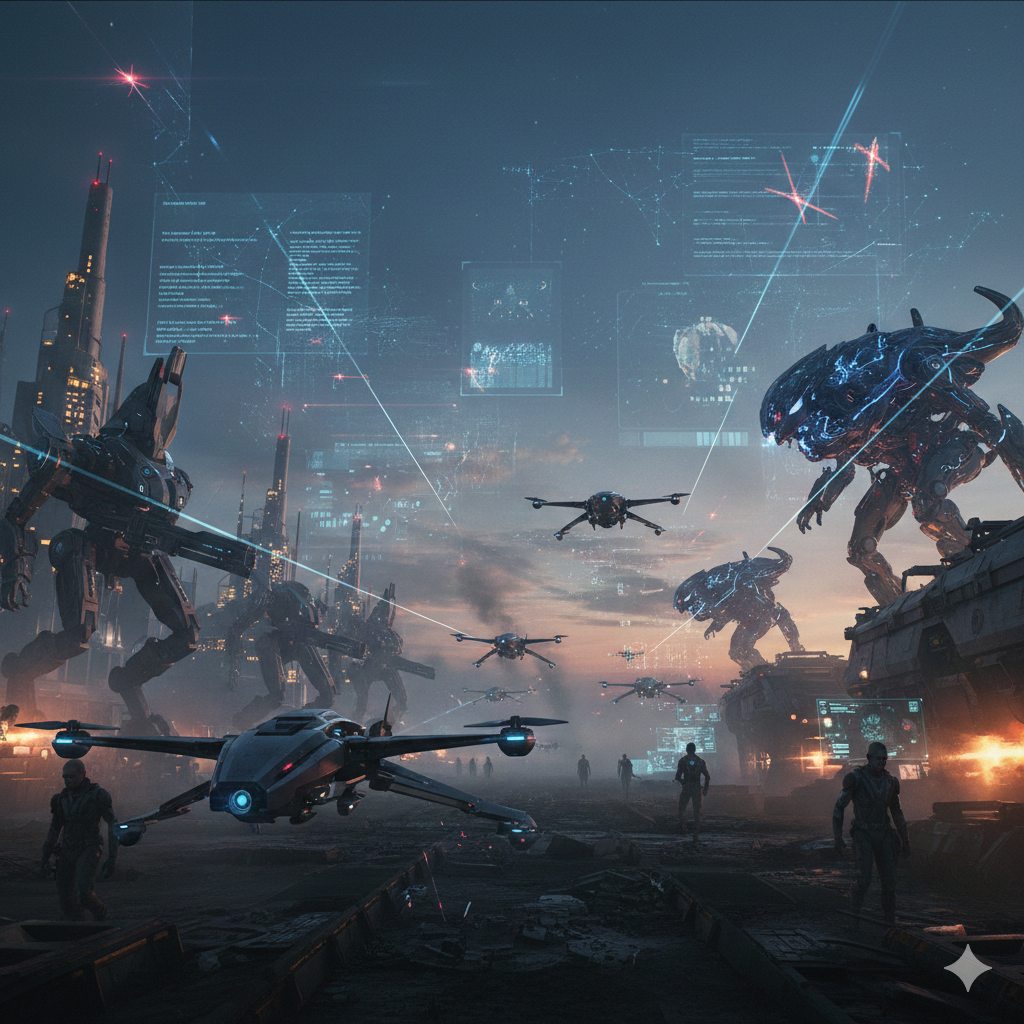
The strategic stakes are equally high on the security front. AI capabilities are becoming decisive for national defense, enabling faster intelligence analysis, autonomous weapons systems, and real-time decision support on the battlefield. U.S. military planners warn that falling behind in AI could leave armed forces at a “severe disadvantage on future battlefields”. Reflecting this urgency, the U.S. National Security Strategy explicitly names AI as one of the “domains that will decide the future of military power,” alongside quantum computing. In essence, AI supremacy is seen as essential to both economic competitiveness and military preeminence. Both Washington and Beijing recognize that leadership in AI could confer not just tech bragging rights, but long-term dominance in innovation, and even the ability to shape global norms and standards to their advantage.
U.S. and China: Two Strategies, One Goal
China’s playbook for AI leadership is assertive and centrally driven. Beijing’s national roadmap calls for China to become the world’s premier AI innovation center by 2030, and it is backing that vision with heavy state investment and unrivaled data scale. Chinese tech companies benefit from a huge domestic market and oceans of data, especially given looser privacy constraints. Moreover, China’s government has shown willingness to mobilize resources and mandate AI adoption in key sectors (from smart cities to surveillance), ensuring AI development aligns with national goals. This top-down approach has already produced world-class achievements, from record-beating facial recognition systems to advanced AI research labs, and it underpins China’s confidence that it can catch up to or surpass the U.S. in the coming years.
The United States, by contrast, is leveraging its strengths in innovation, academia, and industry while crafting a more decentralized but comprehensive strategy. America’s AI Action Plan 2025 provides a blueprint to “win the AI race” by expanding infrastructure, fostering innovation, and guiding AI development in line with U.S. values. One core insight from this plan is that achieving AI supremacy isn’t just about clever algorithms; it requires massive computational infrastructure behind the scenes. Cutting-edge AI demands cutting-edge chips, sprawling data centers, and an enormous electricity supply. Here, the U.S. faces a reality check: its progress is currently constrained by aging infrastructure, notably an electric grid that hasn’t seen major expansion since the 1970s. China, by comparison, has rapidly built up a modern grid and giant server farms to support AI growth. To close this gap, U.S. strategy calls for upgrading power capacity and modernizing energy infrastructure, essentially building “a grid to match the pace of AI innovation,” since the electrical grid is “the lifeblood of the modern economy and a cornerstone of national security”. This means new investments in power generation and transmission to ensure AI supercomputers can run at full throttle.
At the same time, the U.S. is cutting red tape to speed up the build-out of AI facilities. New policies aim to fast-track permits for data centers and semiconductor fabs, using measures like streamlined environmental reviews and opening federal lands for tech projects. The goal is to accelerate the “physical backbone for AI, factories to produce chips, data centers to run those chips, and new sources of energy to power it all”. This reflects a broader recognition that time is of the essence: delays in building capacity could mean falling behind in the AI race.
Another pillar of the U.S. approach is investing in people and open innovation. Washington is funding programs to train a skilled AI workforce and attract top talent, knowing that human expertise is as important as hardware. Notably, the U.S. is championing open-source AI models as a strategic advantage. Open-source AI (where code and even trained model weights are publicly available) enables startups, academics, and smaller companies to innovate without relying on tech giants’ black-box systems. It also appeals to international partners and businesses with sensitive data who prefer transparent, inspectable AI over opaque proprietary models. U.S. officials see an opportunity for American democratic values to shape global AI norms by promoting openness and transparency in AI, in contrast to the more centralized, state-monitored AI emerging from authoritarian regimes. As the White House’s plan puts it, “open-source and open-weight models could become global standards... they also have geostrategic value”. In parallel, the U.S. government is scrutinizing advanced AI systems coming out of China for biases or censorship aligned with Communist Party doctrine, underscoring that the AI contest is ideological as well as technological. Fundamentally, it’s a competition between differing visions of how AI should develop and be used in society.
The Road Ahead: Innovation, Rivalry, and Implications
As we look toward 2026–2030, the U.S.-China AI race is poised to accelerate on multiple fronts. Each nation will likely double down on what it does best: China, leveraging state-driven initiatives and vast datasets, and America, harnessing its vibrant private sector, research universities, and alliances. We can expect rapid advances in AI applications from healthcare to finance, but also in military spheres (as explored later in this series). Integrating AI into defense is already a priority for both countries, since military power may hinge on who better exploits AI for intelligence and autonomous systems. In the U.S., close collaboration between the Pentagon and tech industry is underway to ensure the armed forces have access to cutting-edge AI, from AI-augmented reconnaissance to autonomous drones. China, meanwhile, speaks of “intelligent-ization” of warfare, aiming to weave AI into every aspect of its military.
The economic implications of this rivalry are immense. If the U.S. maintains an AI edge, it could reinforce the dollar’s dominance and America’s overall economic leadership, instilling confidence among investors and allies. Indeed, winning the tech race has a monetary angle: continued U.S. tech leadership would bolster the world’s faith in U.S. financial and currency systems. Conversely, if China were perceived as the new global tech hub, more nations might see it as an attractive partner, and even diversify away from U.S. technologies or the dollar over time. Therefore, staying ahead in AI is not just about bragging rights; it underpins broader economic security.
For the global public and policymakers, this unfolding AI competition carries a mix of promise and concern. On one hand, faster AI development could mean breakthrough innovations, smarter products, and solutions to big challenges (like climate modeling or medical discoveries). On the other hand, an unchecked AI arms race raises ethical questions and risks; from biased algorithms to autonomous weapons. There’s a growing realization that leading in AI also means leading in setting rules of the road. We may see efforts for international agreements on responsible AI use, much as nuclear powers eventually crafted arms control pacts. The U.S., positioning itself as a champion of ethical AI, will push for norms that reflect democratic values, such as banning AI-powered lethal weapons that lack human oversight. But it will only have the clout to shape these norms if it remains a top AI power.
Implications: In this intensely competitive climate, both America and China are racing not just to innovate, but to implement AI at scale in ways that bolster their economic and security interests. The next few years will likely bring further national investments, landmark AI breakthroughs, and possibly some geopolitical friction; for example, disputes over advanced chip exports or talent poaching. For businesses and innovators, the U.S.-China AI contest could spur opportunities (in funding, collaborations with government, or new markets for AI solutions) but also uncertainty (regulatory changes or export restrictions). Policymakers must balance accelerating AI progress with managing its risks, all while keeping an eye on the international playing field.
At its heart, the race for AI supremacy is about which nation will set the pace of technological change in the 21st century. The United States’ wager is that its open, innovation-driven ecosystem, turbocharged by strategic government support, will outlast China’s top-down surge. China is betting that sheer scale and state focus can vault it into the lead. For the world, the outcome will influence not only who has the most advanced machines but whose values guide the AI era. And regardless of who “wins” this race, the competition itself is already ensuring that AI will transform our economies, militaries, and daily lives at a faster pace than ever before. Staying informed and engaged with these developments is crucial for all stakeholders, from startup founders to voters, because the AI policies and investments made now will resonate for decades.
By keeping its foot on the gas in AI R&D and infrastructure, while promoting an open and ethical innovation culture, the U.S. aims to remain “the world’s most advanced and innovative” AI power in the years ahead. The coming decade will reveal how this grand strategic contest plays out, and whether global AI development becomes a story of rivalry, collaboration, or a bit of both.


Comments ()